
07 December 2025
The Hard Edge of the Labour of Time Andrea Knezović & Yeşim Akdeniz
Review by Elâ Atakan
Curated by Àngels Miralda
PAKT Foundation
Zeeburgerpad 53
1 November – 7 December
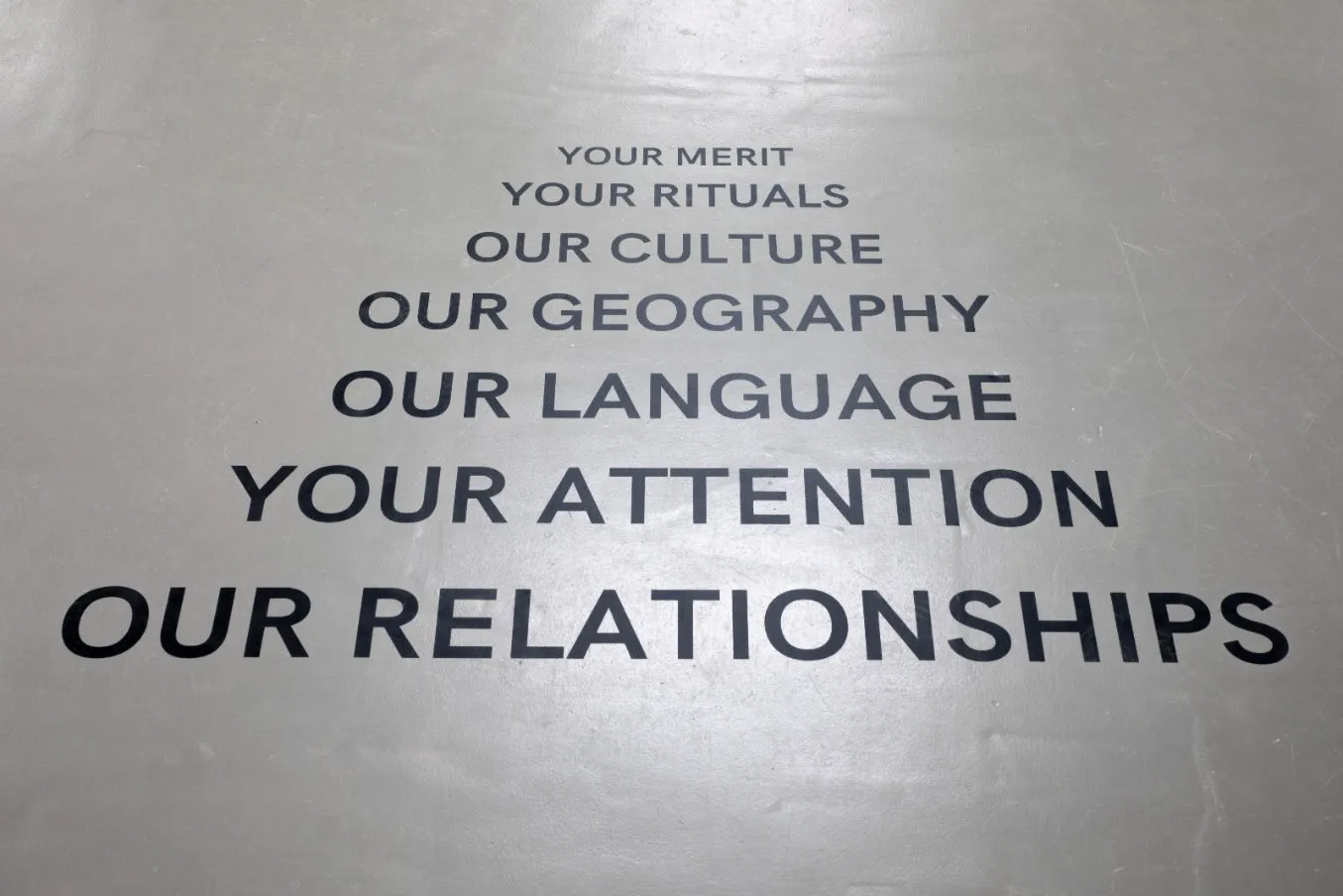
Andrea Knezović, As Above, So Below (The Constellation Series), 2025. Large-scale vinyl diagrammatic spatial installation, variable dimensions.
The Hard Edge of Labour of Time, curated by Àngels Miralda, is on view at PAKT Foundation from 1 November to 7 December. The exhibition brings together works by Andrea Knezović and Yeşim Akdeniz, positioned in a tightly woven dialogue that unfolds across the space. Using different materials and visual vocabularies, both artists articulate through their distinct symbolic languages the exploitation of popular culture and labour under capitalism, as well as the framing, suppression and pacification of the individual through identity politics, and the ways in which life is pulled out of its natural rhythm and drawn into a timeless void. In this context, Miralda’s curatorial approach, shaping the space as a layered site of encounters, adds an additional layer of interest to the exhibition.
When entering the exhibition, we are confronted with words whose letters grow increasingly larger, creating the impression of someone shouting directly into our faces: YOUR MERIT / YOUR RITUALS / OUR CULTURE / OUR GEOGRAPHY / OUR LANGUAGE / YOUR ATTENTION / OUR RELATIONSHIPS. This visual address comes from Andrea Knezović’s installation As Above, So Below (The Constellation Series). Drawing the viewer in from the very first moment, the work sets the initial framework of the exhibition: here, the decision-maker is “the other,” while the exploited subject is “us.”
28 Feburary 2025
“DL Review: André Stempfel at The Merchant House / Amsterdam”, Daily Lazy, February 2026.
Review by Elâ Atakan
The Merchant House, Your House
André Stempfel
12 December – 28 Feburary
The Merchant House
Herengracht 254
1016 BV Amsterdam
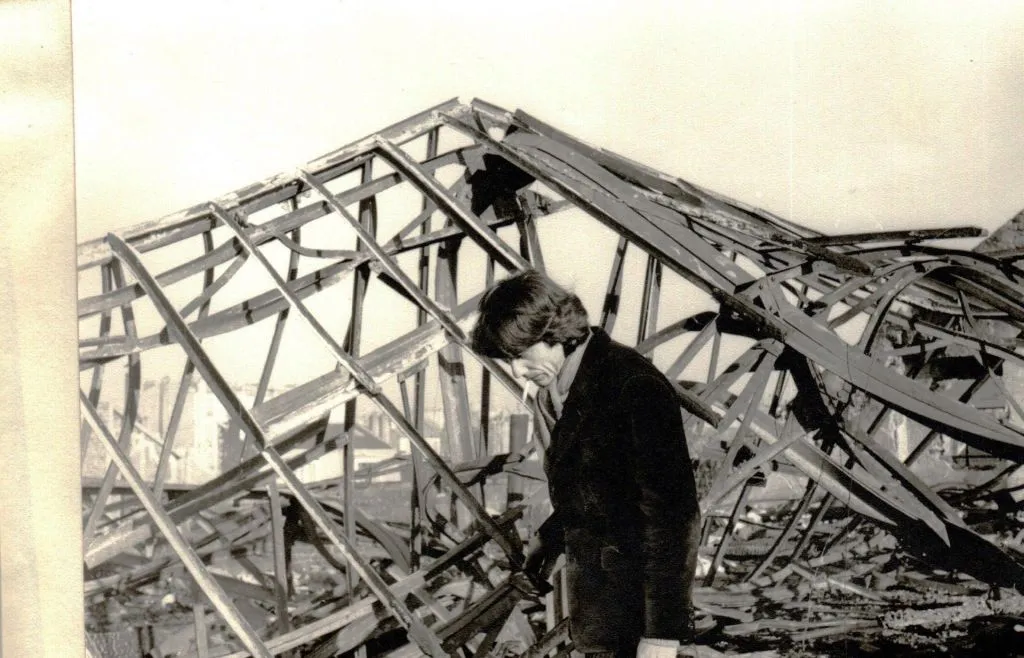
After the studio fire, 1970, Paris.
The Joy of Yellow
On André Stempfel’s Practice
The exhibition André Stempfel: The Merchant House, Your House, unfolds through a scenography conceived by curator and Founding Artistic Director Marsha Plotnitsky, inviting the visitor not into a conventional exhibition space, but into a space akin to a house. The venue is conceived as a space inhabited by the works themselves, at The Merchant House Gallery. Stempfel’s emblematic yellow paintings, his sculptures animated by a sense of movement, and the sky-blue sofa, a recurring motif in his practice, together compose a domestic and familiar atmosphere. The exhibition thus places the viewer less in the position of a visitor than in that of a guest, wandering through the artist’s house-studio.
Born in 1930 in Villeurbanne, André Stempfel developed, over the course of his long career, a practice situated at the boundary between painting and sculpture. Rather than providing answers, his work raises questions about form, space, surface, and the third dimension. These inquiries never take the form of grand demonstrative gestures, but instead manifest through slight displacements, subtle deformations, and unexpected passages, which Stempfel himself refers to by the term clinamen.* Distinguishing himself from his contemporaries without ever opposing them head-on, his work has nevert
heless never renounced a dimension of joy and humour.
Stempfel’s artistic training began in Lyon, where he was introduced to painting at an academy run by a pupil of Albert Gleizes, whom he met on several occasions. After his family moved to Grenoble, he continued his studies at the city’s art school and university. In 1955, he travelled to Italy and then spent an extended period in Greece, where he produced numerous drawings and deepened his research into space and light, nourished by the ancient environment. In 1958, he settled in Paris, worked at the Académie de la Grande Chaumière, and gradually developed his personal visual language. In 1959, his works were selected for the Salon de la Jeune Peinture, of which he would later become a jury member; in 1960, he was permanently represented by the Galerie d’Art du Faubourg (Étienne Pépin). During this period, he also frequented Parisian intellectual circles.
In 1970, a fire devastated his Paris studio and destroyed almost all of his earlier works. At the age of forty, Stempfel experienced a decisive rupture, both material and artistic. To this loss was added a period of illness that the artist describes as “very difficult.” The dark and romantic paintings of his early years gradually gave way to an opening toward colour. “Little by little, I moved toward colour… and then there was that fire.”
1 March 2026
“DL Review: The Waves, curated by Nesli Gül at Contour Gallery / Rotterdam”, Daily Lazy, February 2026.
Review by Elâ Atakan
The Waves
Curated by: Nesli Gül
Gamze Öztürk, Anouk Kruithof
Lana Mesić, Mesut Öztürk
17 January – 1 March 2026
Contour Gallery
Josephstraat 164
3014 TX Rotterdam
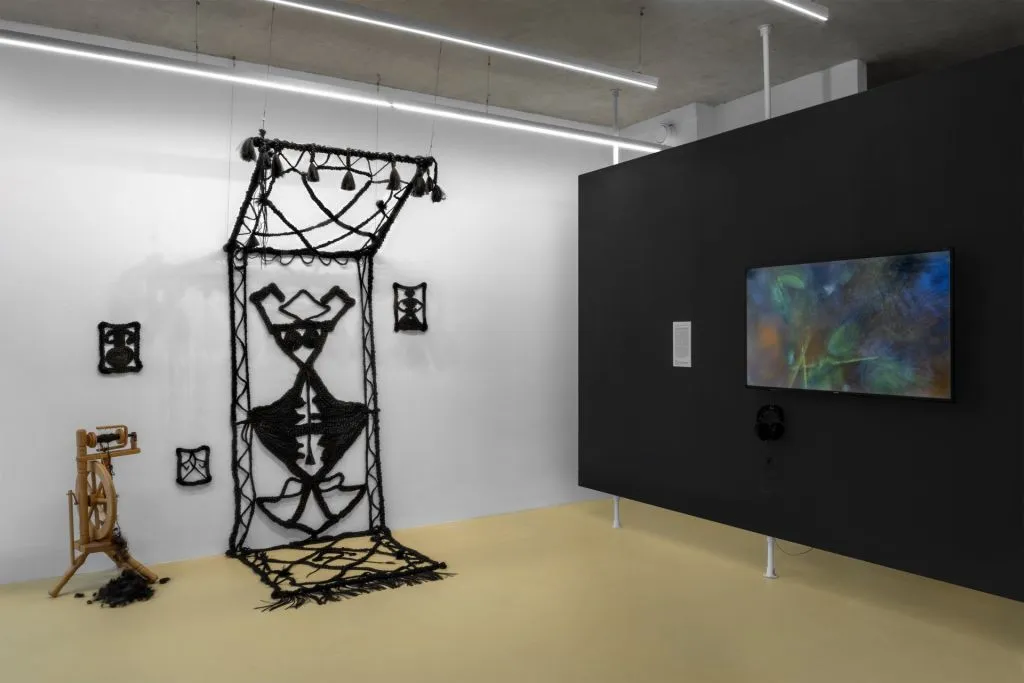
Gamze Öztürk, Hands-on-Hips, 2023–ongoing, Synthetic and human hair mix. Installation and performance
Anouk Kruithof, I Identify As, 2024, Single-channel video installation, 10:54 min
Photography: Hasan Özgür Top
The group exhibition The Waves opened on January 17 at Contour Gallery in Rotterdam, curated by Nesli Gül. It approaches identity not as a fixed form of belonging, but as a fluid and permeable state of becoming. The exhibition draws its inspiration from Virginia Woolf’s novel of the same title. In Woolf’s text, each character carries a distinct voice and narrative; yet all grow up on the shore of the same sea, shaped by the rhythm of the same water. Similarly, the artists brought together in this exhibition converge within a shared current, departing from different stories and materials.
In the exhibition, materials shift and transform in unexpected ways. A carpet is woven not from thread, but from human hair cut from the body. Archival images are built out of matches, carrying within them the latent possibility of ignition and conflict. The body, plant life, and technology seep into one another, blurring their boundaries. Ceramic, a material that does not bend without breaking, is forced into precarious balance, held together by clamps and constantly on the verge of collapse.
These material transformations mirror the artists’ own experiences of displacement and shifting identity. The place of birth, the nation one belongs to, the geographies one moves through all remain in flux. Identity, like material, must be constructed again. As in Woolf’s sea, boundaries here are unstable; each wave belongs to the same body of water, yet moves in its own direction.
Gamze Öztürk’s performance and installation Hands-on-Hips opens one of the most direct spaces in The Waves where the boundaries of material and identity are pushed to their limits. Referencing the tradition of Anatolian carpets and kilims, the work replaces thread, the primary material of weaving, with human hair. A fragment of the body becomes both the medium of production and the surface that carries meaning. Woven live during the performance, this hair carpet activates layered cultural codes. In Anatolian kilims, each motif carries symbolic traces of a period, an experience, or a desire in the life of the woman who weaves it. Within this context, the hands-on-hips motif can be read as a powerful sign referring to bodily posture and social positioning in Anatolian culture. Similarly, hair in Anatolia is not merely a biological element; it carries dense meanings related to marital status, social position, and identity. Forms such as single or double braids allow for cultural readings associated with marriage and desire.
30 November 2026
“DL Review: Along the Road in Rearview at The Merchant House / Amsterdam”, Daily Lazy, December 2025.
Review by Elâ Atakan
Along the Road – In Rearview
Leo Vroegindeweij & Ruth Meijer
3 October – 30 November
The Merchant House
Herengracht 254A,
1016 BV Amsterdam
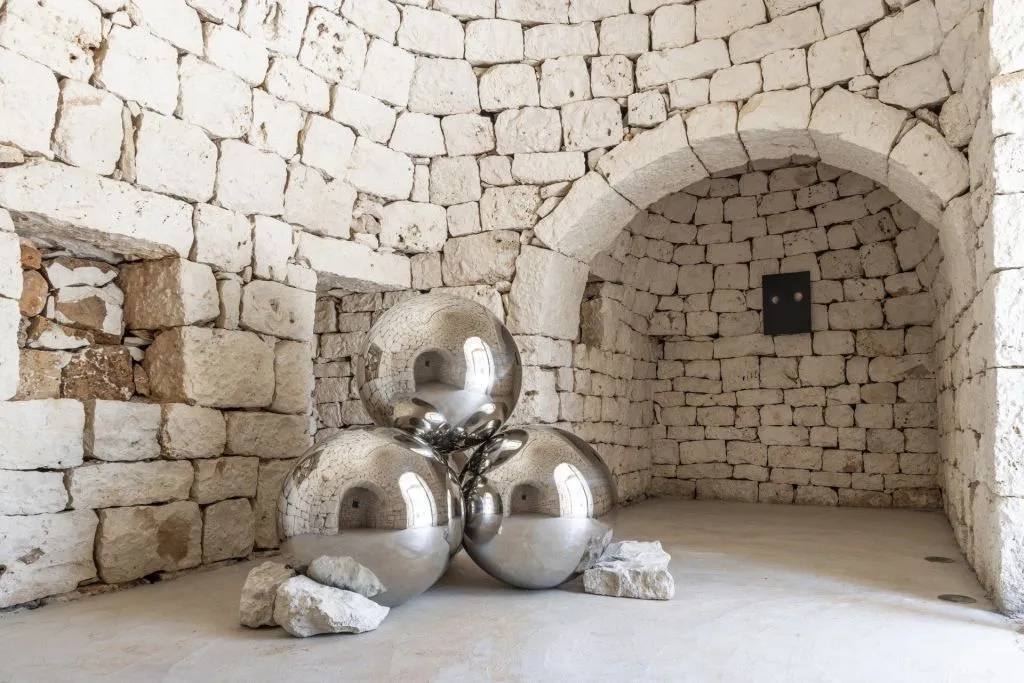
Leo Vroegindeweij, Untitled, 2025, Limestone, stainless steel, 99 x 141 x 127 cm
Ephemeral project for Dep Art Out Trullo, Ceglie Messapica (IT), June 14–15, 2025
Courtesy of Dep Art Out, Ceglie Messapica
Photography: Fabio Mantegna, Milan
The Merchant House celebrates the 50-year partnership of Dutch sculptor Leo Vroegindeweij and painter Ruth Meijer with an exhibition. Titled Along the Road – In Rearview, the show conveys not only their works but also the story of a relationship, a journey, and the interplay of reflections.
Leo Vroegindeweij, who has exhibited at ARTZUID Amsterdam in 2017, the TMH Style Room in 2023, and various venues in France, is represented in the Kröller-Müller Museum collection and numerous public spaces. Working with durable materials such as stone, metal, and concrete, he creates his renowned metal spheres, whose reflective surfaces introduce a fleeting, ephemeral quality despite their enduring solidity. These spheres function as mirrors, reflecting not only the surrounding space but also its interior and the viewers themselves, enriching the exhibition with both visual and conceptual depth.
In the summer of 2025, Vroegindeweij staged a one-night ephemeral exhibition within the architecture of a Puglian trullo as part of the Dep Art Out program. The trullo, a traditional dry-stone structure whose stones can be dismantled and reassembled without mortar or cement, provided a perfect setting to embody the dialogue between permanence and transience.
7 Feburary 2026
“DL Review: Gabriella Boyd · I Trust You Would at GRIMM / Amsterdam”, Daily Lazy, February 2026.
Review by Elâ Atakan
I trust you would
Gabriella Boyd
12 December – 7 Feburary
GRIMM
Keizersgracht 241,
1016 EA, Amsterdam
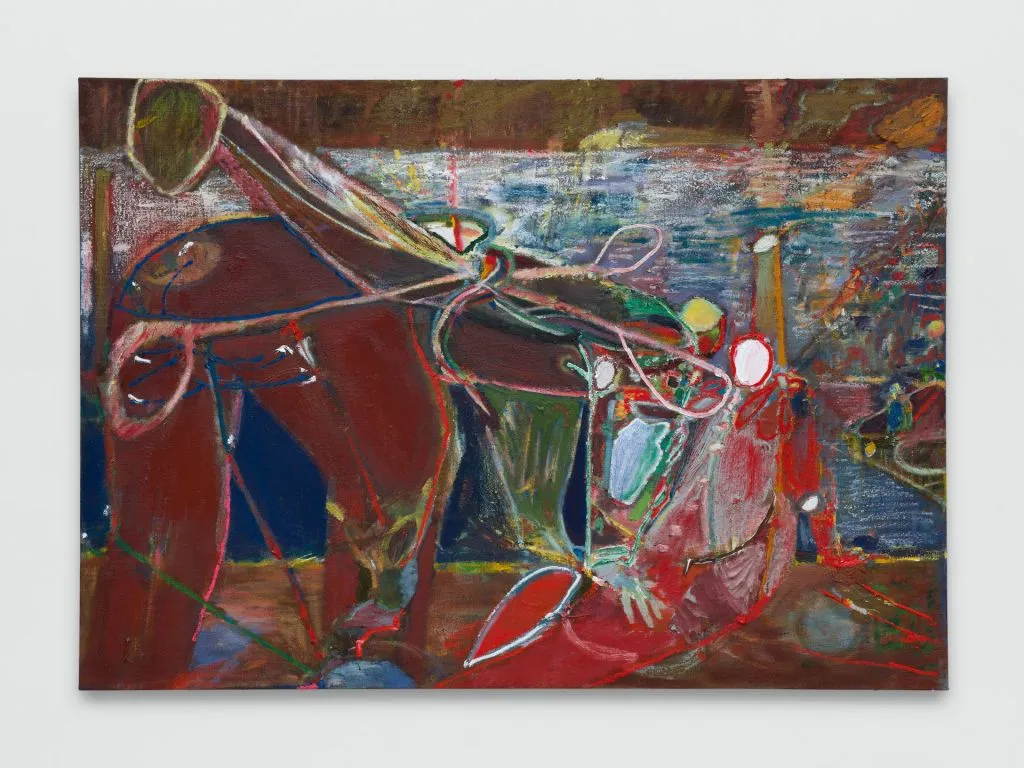
Gabriella Boyd, Lumbar Scene, 2024-2025, Oil on linen, 95 x 135 cm | 37 3/8 x 53 1/8 in, Photography: Ollie Hammick
Spinning Time Through a Dream Field
On Gabriella Boyd’s Work
Gabriella Boyd’s I trust you would, on view at GRIMM Gallery from 12 December to 7 February, approaches painting not as a means of representing the world, but as a space where sensory and bodily experience gathers and settles in layers. Boyd’s scenes unfold according to a dream logic: psychological configurations that feel intimate yet held in suspension, in which inner and outer states gently fold into one another. In Boyd’s own terms, the paintings are conceived as “psychological spaces,”* less concerned with describing situations than with giving form to what has no material presence: the space between two people, the at
mosphere of a room. Across the exhibition, time and space drift into a shared state of indeterminacy, realized through a layered construction that recalls the way a dream is remembered rather than seen.*
Colour plays a central role in this condensation of experience. Rather than functioning descriptively, it operates as a bodily register, something felt before it is read. Boyd has often spoken about colour in direct relation to the body, recalling yellows that evoke bile, bodily fluids, or internal unease.* In I trust you would, these chromatic sensations deepen and thicken. Browns emerge across the works, not as surface tones but as layered accumulations, suggesting states closer to coagulation, soil, skin, or old blood than to fresh injury. In works such as Lumbar Scene, this brown reads as a slow, enduring condition, less an open wound than a site of care, pressure, and containment. As Boyd describes her process, colour arrives through a combination of intention and intuition, adjusted to change the emotional temperature of a painting, until it begins to feel, in her words, “like a bruise, or a platelet.”* Here, colour does not decorate space; it inhabits it, carrying the weight and density of lived, bodily time.
The title I trust you would carries this sense of duration into a more fragile register of trust and endurance. Boyd has linked the title to her experience of giving birth, a moment she describes as requiring both the greatest inner strength and a complete surrender to the situation. This paradox of solitary bodily intensity combined with reliance on others resonates throughout the exhibition, infle
cting its atmospheres with a sense of suspension and vulnerability. The title itself carries a hesitation, a conditional tone that mirrors the emotional register of works such as Lumbar Scene.**
Seeing, in Boyd’s work, is never a purely optical act but a bodily one, unfolding from within rather than directed from outside. Vision is shaped by sensation, memory, and internal imagery, collapsing the distinction between what is seen and what is felt. This understanding is informed by Boyd’s experience of her grandmother’s blindness, when images persisted through imagination rather than sight, carried internally and translated through memory.* “So much sitting and looking in close proximity, beds becoming landscapes themselves.”** According to Boyd, moving frequently during her childhood also made her aware from an early age that different spaces can change the way one feels, and that ‘‘the shapes of rooms can affect the mind on an abstract level’’.* This sensitivity extends to her painted environments, where the boundaries between body and architecture dissolve. Floor plans, rooms, and windows become emotionally charged, behaving less as neutral structures than as bodily forms. In works such as Heart (2024), Heart (v) (2024–2025) the form operates on multiple registers at once, reading both as the floor plan of the artist’s studio and as a symbolic reference to her father’s heart. Architecture and anatomy overlap, underscoring Boyd’s tendency to conceive space itself as a body. Time and space are not organised sequentially here, but layered, allowing different moments and states to coexist.
1 March 2026
“DL Interview: A Single Horizon. A Conversation with Reinoud Oudshoorn at Galerie Ramakers / The Hague”, Daily Lazy, March 2026.
In his recent solo exhibition “Limit everything to the essential, but do not remove the poetry” at Galerie Ramakers (1 February–1 March 2026), Reinoud Oudshoorn presented a constellation of sculptures in steel, wood, and frosted glass that appeared at once meticulously resolved and precariously held. Installed across walls, corners, and floors, the works did not simply articulate space, they recalibrated it. Their geometric discipline established a rigorous visual order, yet within this precision lingered a quiet instability: a tension between structure and suspension. In the following interview, Oudshoorn speaks about
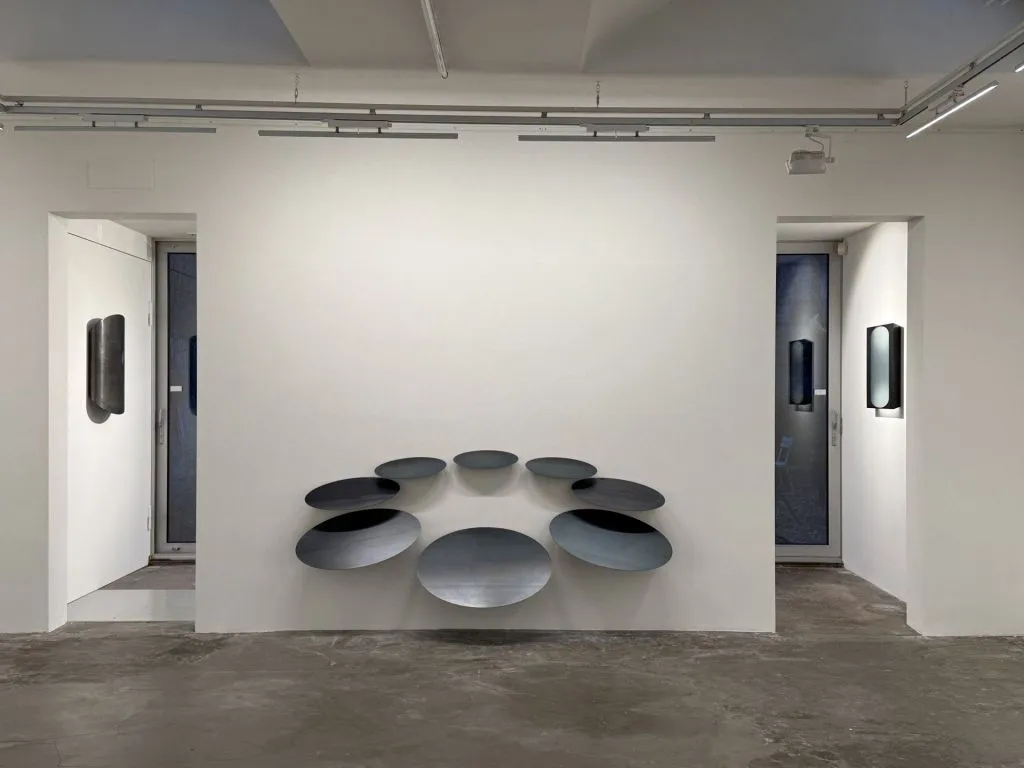
his working process, his long-standing exploration of perspective, and the discipline required for his constructions to hold both literally and figuratively.

Elâ Atakan: While looking at your glass works, one senses that depth is both revealed and suspended at the same time; behind what is visible, there seems to be a subtle, almost mist-like ambiguity. With such minimal intervention, you construct a space where perspective appears to be simultaneously activated and destabilized. Is this dual movement between producing depth and withholding it an extension of your early engagement with perspective in two dimensions, now translated into sculptural form?
Reinoud Oudshoorn: My creative process has several stages. First comes the dialogue between myself and the empty white wall in my studio. Through this absence of presence, my imagination is let free to roam. At a certain point, new ideas start to evolve.
The second stage is when I explore my ideas in simple small line drawings. Thirdly, I will then choose one or more of these line drawings to, in actual size, investigate the construction of the 3D end-piece.
The drawings in my 2026 solo exhibition refer to three of my wooden sculptures which are made with multiple layers of waterproof birch plywood. The drawings are an integral part of the construction process, not only to get a feel for the size and dimensions of the end piece but also to literally know how to cut each layer of wood.
For my steel constructions, the work is usually built and welded on top of the life-size drawings, which will more often than not be damaged or burnt by the heat of the welding.
E.A: Although your sculptures are made of industrial and often cold materials such as steel and glass, they evoke a planetary alignment, a kind of cosmic order. There is a palpable tension between organic associations and mechanical precision. Is this contrast intentional? And does the delicate balance you establish between gravity and counterforce contribute to this almost celestial sensibility?
R.O: My choice of material is as pure and honest as I can get it. Neither the steel nor the glass pretend to be anything else than what they are. Maybe the connection with nature is that a tree does not pretend to be a tree.
I certainly explore certain contradictions in touch and physical weight. For example, with the seeming softness of the brittle frosted glass or the floating nature of the large and heavy steel pieces.