
Catalog text
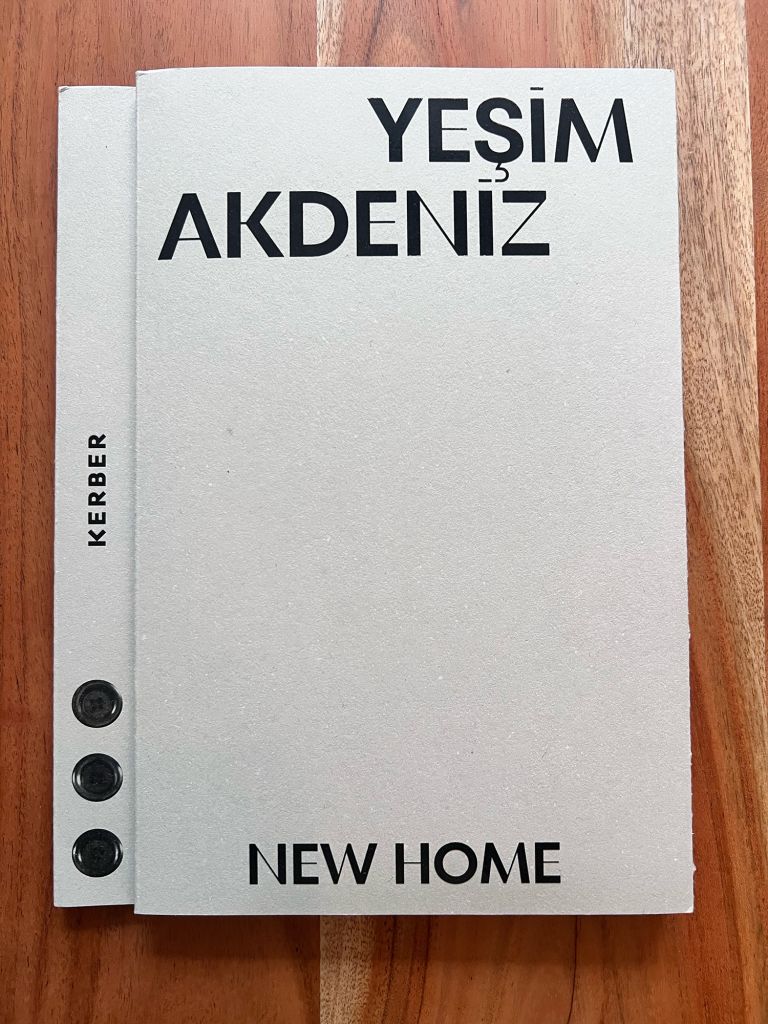
Catalog Text for New Home
In her art practice spanning more than twenty years, Yeşim Akdeniz has reinforced moments of conflict, cultural and socio-political concepts with theories and placed the objects they represent with a semiotic technique, with the help of dynamic painterly composition. In her productions in various mediums, from paintings to textile works and textile-silicone-metal assemblages, she uses a vocabulary of objects encoded with her personal symbolism that she has synthesized over the years to express social injustices created through gender inequalities, class, and racial differences. Therefore, when we examine the roots of her works, although they stem from personal experience, they emerge as ‘the projection of individual experience on society’, and the reflection of the reality of a socio-political, economic, or cultural conflict in daily life.
In Yeşim’s works, the expressions of these socio-political and cultural conflicts, which oppress the individual into the acceptable identity they should have through good social engineering in the reality of life, emerge through the aesthetic and sensory representation of culture-carrying objects. Upon close inspection of her works, which are soft, clean-cut, and of colours that are pleasing to the eye, containing objects that are well-designed or meticulously mimic existing designs, there is a conscious sense of disruption to this visual harmony, a sharp, ironic expression that conflicts with itself through the incorporated materials. It delivers the viewer from that first compassionate feeling to an uncanny feeling, highlighting the reality of the injustice they want to draw attention to.
In her exhibition titled ‘The Man’, held in London in 2006, Yeşim Akdeniz moves from canvas to embroidery on textile for the first time. For centuries, upholstery has been a field of production culturally associated with women and the domestic. In this exhibition, the artist creates the sombrero, a symbol of male power, and the steamboat, the first sign of the industrial revolution, by using feminine colours and combining various bright, floral-patterned textiles, castrating symbols of masculine power by feminising them. According to the artist, the work titled ‘The Man’, also featured in this exhibition, is among the objects that depict male power and carry social dress codes such as jackets and belts, which she frequently uses in her works.
The drawings that are included in the exhibition ‘Flanged’ are another series where the artist touches upon gender and class issues through dress codes. We encounter the image of fur in her earlier drawings; fur, in addition to indicating the class status of women in society, also underlines the borrowing of the superiority of the slain animal in nature. Fur adorns and exoticizes the female body, making her reassert her role in society through a commodity. Just as fur has been replaced by specially designed puffer jackets on a class level today, the symbol of the cultural code in the artist’s drawings turns into puffer coats.
Puffer jackets hold a special place in the artist’s vocabulary of symbols coded into objects. In her exhibition ‘Insituwo’, which opened in Brussels in 2019, Yeşim Akdeniz describes the unstable nature of immigration through puffer jackets floating in water in her oil painting on linen series titled ‘Once an Immigrant Always an Immigrant’. Coats of well-known sports brands were used by lower socio-economic groups, including immigrants, because they kept one warm, despite their cheap materials. This later became one of the examples of cultural appropriation, a form of colonialism, by the advantaged classes, particularly often seen in fashion design. Today, rare collections of the same sports brands replace fur as class symbols, and reproduce social inequality.
In her series titled ‘Radical Selfcare’, exhibited as part of ‘Orienting Around ‘in The Hague in 2021, the artist upholsters textiles by combining them with a quilting technique used for centuries in Anatolian culture. In her series called ‘Self Portrait as an Orientalist Carpet’, Yeşim refers to the book Orientalism by Edward W. Said, published in 1978. In the book, Said describes and criticises the West’s disdain for the East, the Orient. In her series of works, Yeşim creates textile reliefs with protruding pockets, eyes resembling evil eye beads, jacket cuffs symbolising masculine power, work bags, chains, tassels, and pumpkins, and symbols encoded in her objects, tightly attached in layers. With an ironic perspective in these works, she carries over all the conflicts from her previous works; they respond to the ‘other’, masculine power, and identity problems by creating their own orientalist perspective. According to Said, the West produces its own identity by constructing an ‘other’ who speaks, thinks, and writes differently from itself. It is quite significant that the artist associates herself here with the carpet, one of the indispensable objects of Orientalism. Similarly, in the continuation of the series with the embossing and quilting technique on textile, we encounter a work titled ‘Mistrust of the Suburban’, composed of wood panels similar to a divider.
In her exhibition titled ‘Well-Gone’ in Cologne in 2023, sportswear fabrics that refer to the clothing codes of immigrant societies take on a different visual dimension with the use of silicone material. The works titled ‘TBA’ (To Be Agreed) once again underline that the immigrant class dreams of a future of approval and acceptance, similar to what we see in the series ‘Once an Immigrant Always an Immigrant’. These works feature reliefs of peppers, aubergines, and bananas, simultaneously evoking phallic imagery and exoticism. In Yeşim Akdeniz’s visual and symbolic fiction encoded into her objects, the colour tones she chooses for her silicone backgrounds symbolise skin colours. As she continued to work with silicone as a material, the artist found it significant that brown cannot be reproduced as a colour. In this series, Yeşim refers to the ‘brown identity’ theory. The silicone material reminds us of skin, not only because of its colour, but also because of its quality; and the objects are mounted with sharp metal wheels, frilly-edged polishing discs, circular saws, and door locks on jade with screws. The artist finds a parallel in this intervention to silicone with the West’s penetration into the other’s identities, all their weaknesses, gaps and holes within the framework of a system. According to her, this designed pressure creates a compelling sensation, like metal moulds being driven into the skin. Just as she did in her work ‘The Man’, in which she embroidered with glittering, stony textile that represent male power, Yeşim here creates compositions that at first glance look like soft and cute, frilly pattern works, by using cutting and polishing construction materials that are under male power. She has collected the construction materials she used in this series from second-hand shops in Brussels, where she lives and works.
Architecture also holds an important place in Yeşim Akdeniz’s works. In her ‘Club Dystopia’ exhibition in Istanbul in 2016, she reconstructs some of the symbolic buildings that were demolished and did not survive to the present day, representing the modernisation of the early Republican period in the 1930s in Turkey. These buildings, which are depicted as submerged in water, show that designed modernism in Turkey has failed to resonate with the society. There is also an architectural undertone in her canvases ‘But first you must learn how to smile as you kill’, which she exhibited in 2017, revealing the artist’s ironic perspective and referring to a line from John Lennon’s song ‘Working Class Hero’. Here, the artist draws inspiration from the E-1027 House, designed by architect Eileen Gray in Southern France between 1926 and 1929. The aspect of the architect’s life that captured the artist’s attention is that the female architect, who created this masterpiece, remained in the shadow of her male colleagues throughout her life. Additionally, Le Corbusier, a friend of the architect who frequently visited the house, intervened in her absence by creating six large cubist paintings on the white walls of the house. In her canvases, Yeşim reinterprets the specially designed items in this house in a manner that contrasts with the works of Le Corbusier. She interprets the tension of the betrayal this female architect has been subject to through the design objects she places on her canvases.
In ‘Negotiation’ and other wall works in this exhibition, each of the materials used by Yeşim—wrought iron, relief, and all other incorporated materials—touches on social and historical narratives. Dividers were first used in Chinese culture to block the wind and to create a private space in a room. They were adopted as a mysterious and oriental decorative object by the European bourgeoisie in the 16th century. Yeşim Akdeniz’s divider underlines the Oriental perspective with this fantasy object from the East, adopted and narrated by Westerners. The wrought iron used in this work represents the cultural permeability between Belgium and the Ottoman Empire; the decorations that emerged during the Baroque period in Europe were also used in Ottoman architecture. Motifs similar to those found in Dolmabahçe can also be discovered in Belgium. The silicone she places on textile contains reliefs that she has taken from buildings in Belgium. The colours used in these two works, designed in black and white, again refer to skin and identity issues. The bent neck of the woman figure in ‘Negotiation’, the fact that she is on a screen coming from the East, and the taut upholstery of the textile as in the previous works, strongly reveal the artist’s own object-expression repertoire in these works. Here, Yeşim describes the orientalist perspective, gender inequality and cultural permeability with the materials and objects infused with historical meaning that she brings together.
In Yeşim’s artistic approach, from her works on canvas to her recent textile and silicone works, the attribution of new meanings, whether in an abstract manner or by bringing together and constructing or placing ready-made objects, is a recurring theme. The title of the exhibition Flanged is derived from a cylindrical construction material of German origin, flange, with claws that attach pipes and other structures going in different directions. Flanged appears in this context with an attributed meaning of being attached together. Yeşim’s works are the construction of a new narrative structure in which various mediums come together and take on different meanings. In this exhibition, various materials such as silicone, textile, or metal are used to question the political, cultural, and social issues that the artist deals with.
Elâ Atakan
Yeşim Akdeniz (b. 1978) graduated from Art Academy Düsseldorf in 2002. She was invited by deAteliers Residency Program in Amsterdam in 2002 until 2004 and won the Kunstverein Bonn/Peter Mertes Stipendium in 2005. Yeşim Akdeniz opened her first solo exhibition in Turkey in 2005 at Galerist with the title ‘Atlas Shrugged’ and has participated in exhibitions at many institutions such as Stedelijk Museum, Amsterdam, Kunstverein Frankfurt, Sammlung Philara, Düsseldorf, Kunstverein Bielefeld. Yeşim’s works contain symbolic narratives in which the emergence of the foundations of modernism and its related policies and the forms of cultural production associated with them are used. Yeşim, who frequently uses modernist architectural and design elements and art historical references in her works, seeks answers to how these designs evolved over time. The artist currently lives and works between Brussels and Düsseldorf.