
Catalog text
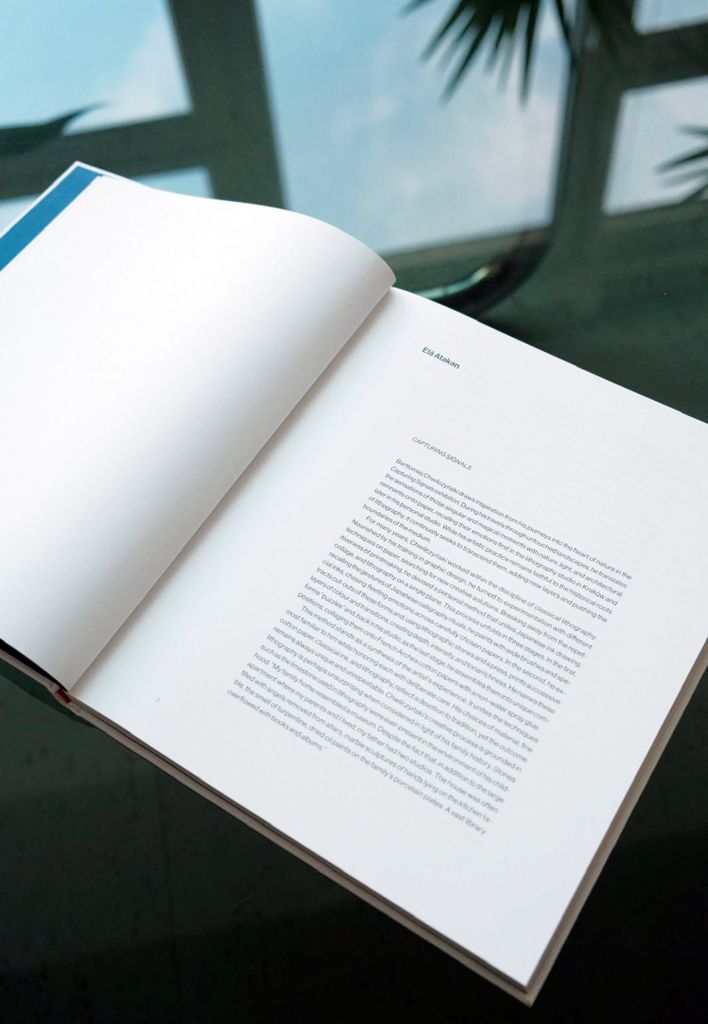
Catalog Text for Capturing Signals
Elâ Atakan
Bartłomiej Chwilczyński draws inspiration from his journeys into the heart of nature in the Capturing Signals exhibition. During his travels through untouched landscapes, he translates the sensations of those singular and magical moments with nature, light, and architectural remnants onto paper, recalling their emotions first in the lithography studio in Kraków and later in his personal studio. While his artistic practice remains faithful to the historical roots of lithography, it continually seeks to transcend them, adding new layers and pushing the boundaries of the medium.
For many years, Chwilczyński worked within the discipline of classical lithography. Nourished by his training in graphic design, he turned to experimentation with different techniques on paper, searching for new creative solutions. Breaking away from the repetitiveness of printmaking, he devised a personal method that unites Japanese ink drawing, collage, and lithography on a single plane. This process unfolds in three stages. In the first, recalling the gestures of Japanese calligraphy rituals, he paints with wide brushes and special inks, chasing fleeting emotions across carefully chosen papers. In the second, he extracts cut-outs of these forms and, using lithographic stones and a press, prints successive layers of colour and transitions, creating depth, intensity, and tonal richness. He names these forms “puzzles” and, back in his studio, as the last stage, he assembles them into unique compositions, collaging them onto French Arches cotton papers with a non-water spray glue.
This method stands as a synthesis of the artist’s experience. It unites the techniques most familiar to him while honoring each with deliberate care. His choices of material, fine cotton paper, classical ink, and lithography, reflect a devotion to tradition, yet the outcome remains always unique and unrepeatable. Chwilczyński’s creative process is grounded in lithography is perhaps unsurprising when considered in light of his family history. Stones such as the limestone used in lithography were ever-present in the environment of his childhood: “My family home resembled a museum. Despite the fact that, in addition to the large apartment where my parents and I lived, my father had two studios. The house was often filled with angels removed from altars, marble sculptures of hands lying on the kitchen table, the smell of turpentine, dried oil paints on the family’s porcelain plates. A vast library overflowed with books and albums.”
His father also worked with another stone, marble, throughout his life. Educated in Art Conservation at the Jan Matejko Academy of Fine Arts in Kraków, he dedicated his professional and artistic career to restoring the splendour of other artists’ works. Renowned for his expertise in marble, he undertook significant restoration work at Wawel Cathedral, including many of the tombstones of the Polish kings laid to rest there. His teachings left a profound mark on the artist. From him, Chwilczyński learned that creativity is not merely the use of a brush but the act of looking and observing. This understanding deeply shaped his perception of art. His father’s last project was the renovation of Storkyrkan Cathedral in Stockholm. Chwilczyński recorded that final journey to Sweden and his last meeting with his father in his sketchbook, and since then, he has carried a sketchbook with him on every journey.
Travel has always been central to the artist’s life. The exhibition Capturing Signals evokes the search for and interpretation of cosmic signals that resonate from encounters in distant geographies. In the photographs included in this catalogue, natural formations, ruins, and landscapes appear as antennas transmitting these signals to the Earth. While the artist spends most of his days in the studio, every year he devotes several months to these journeys. The photographs presented in this catalogue were taken in recent years during his travels to Madeira, Greece (Peloponnese), the Šar Mountains, the border between North Macedonia and Kosovo, Switzerland, and Poland.
The vivid and luminous imagery of his travels since childhood especially Canada became deeply embedded in his memories. Years later, this experience informed his doctoral thesis at the Academy of Fine Arts in Kraków, which examined the collision between remembered places and their present reality, revealing that while most memories fade with time, the wilderness retains its enchantment. The family’s tradition of travel was further enriched by his father’s stories. In the 1970s, before Chwilczyński was born, his father embarked on long journeys to India, crossing Central Asian borders on foot during the Soviet era and documenting every moment with his camera. Preserved as slides, these boxes of films and photographs became a powerful visual archive, an inheritance that shaped Chwilczyński’s attentiveness to observation and continues to nourish his creative practice.
The long-term Journey series may as well draw its name from this lifelong sense of travel. In these works, inspired by calligraphy, the artist engages in the journey of creation itself through sweeping, gestural brushstrokes. The series is characterised by layered colours, intuitive movements, and dynamic abstract compositions. The Postcards series arose as an extension of Journey. Conceived as letters the artist wrote to himself from different corners of the world, these works led him to a new discovery within his practice. For years, he believed his abstractions stood apart from nature, but when he returned to analogue photography to document his journeys, he realised that many motifs in his works were deeply connected to his photographs. This revelation demonstrated that his abstractions were in fact born from close observation of nature and from his way of transforming it. Before creating Postcards, during his travels, he sought out singular moments with nature and architecture, following the subtle signals of the universe and capturing them with his camera. Upon returning, he looked at his photographs anew and discovered a powerful, unexpected connection between them and his artworks. For him, this discovery was a treasure, deepening the meaning of his work and building an unforeseen bridge between abstraction and photography. Viewed alongside his childhood travels, his doctoral thesis, and his father’s photographic archive, the special relationship between Postcards and photography acquires a layered resonance.
In the exhibition space, the works of Postcards appear along a single wall, each narrating its own story while forming a whole or engaging in pairs and trios in dialogue with one another. At times they take the form of a circle resembling a small stain; at others they bear the sweeping, curved gestures of the artist’s brush. Minimal in appearance, they nevertheless assert themselves as independent and forceful presences.
Also included in this exhibition is the series Pyramid of Needs, which introduces a physical dimension to abstraction in its exploration of balance against gravity. Employing the same elements as in earlier works, here the artist composes forms stacked, scattered, and striving to remain in equilibrium. These structures reflect the shifting priorities and needs of human life, collapsing and rebuilding within the natural cycle of existence. Within this process, certain elements endure, providing strength and stability. The photograph of a white-haired woman seen from behind, gazing out to sea, depicts the artist’s mother. Throughout his adventures, she stood beside him like a rock, his constant support. Including her image in the series conveys the sense of balance and foundation that underlies the work.
Capturing Signals brings together two new series, marking a pivotal moment in the artist’s practice. It reveals the visual and conceptual relations Chwilczyński weaves with the signals of the universe while reworking both the artistic heritage inherited from his family and the rituals of travel that shaped his childhood. In this way, the exhibition integrates the layers of his personal history with his artistic practice, endowing his work with new emotional and conceptual depth.